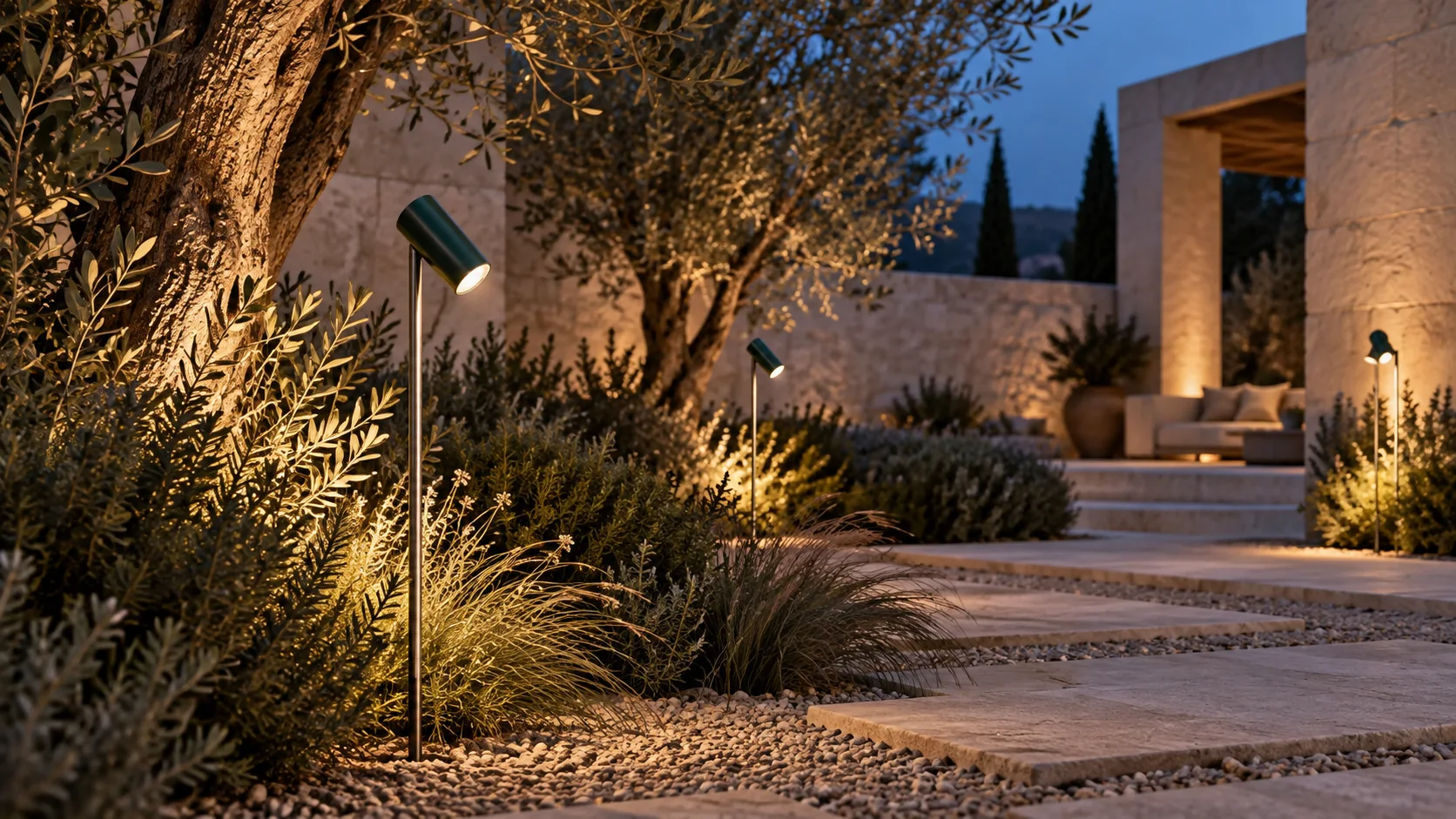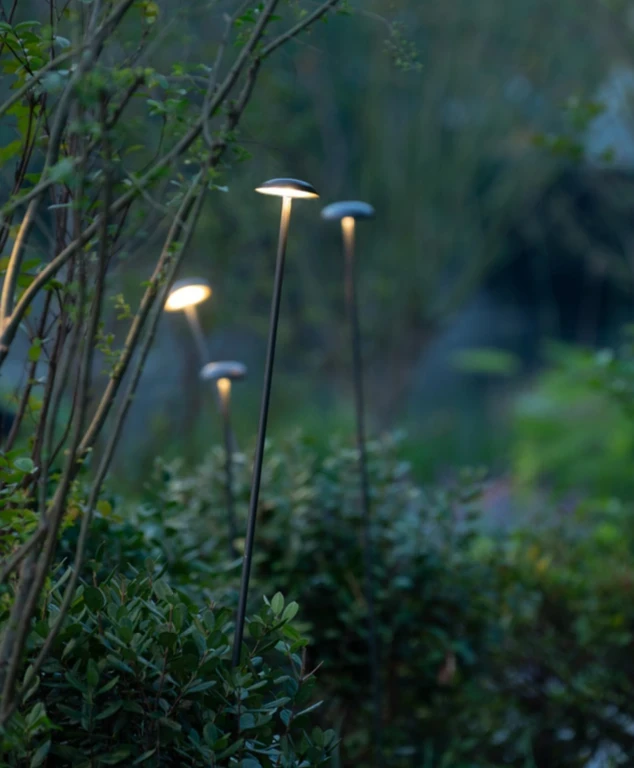
A path is the one part of a garden that must work after dark, and it is the part most often over-lit. Too many bollards, too tall, too bright, and the walk from the gate to the door becomes a runway while the garden on either side vanishes into black. The goal of path lighting is modest: enough light on the surface to read the edge, a step and a change of material, from sources that stay out of the eye. This guide gives the rules we apply when we lay out a run of poles.
How much light a path actually needs
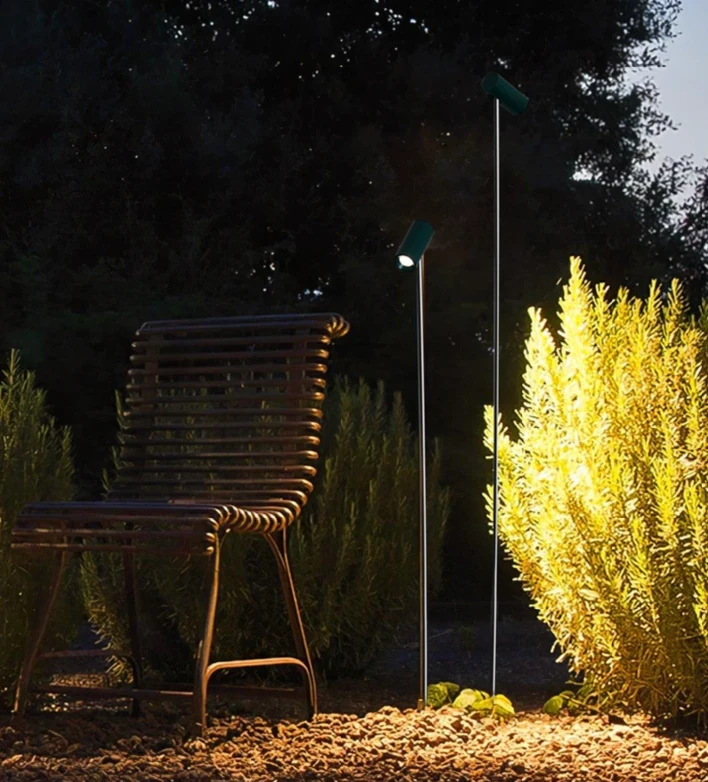
Far less than people expect. A residential garden path is comfortable at 5–10 lx on the surface — a level the eye reads as generous once it has adapted to the night — and a step or a level change wants roughly double that at the tread. For comparison, a lit terrace where people eat sits at 30–50 lx. A single 4 W Acorn or 5 W Lily pole lays that kind of pool at its feet; a 7 W Drum does the same in a tighter 34° cone. The number to resist is the lumen figure on a bollard datasheet: 1000 lm from a mains bollard is a security level, not a garden one.
Height sets the circle, spacing follows
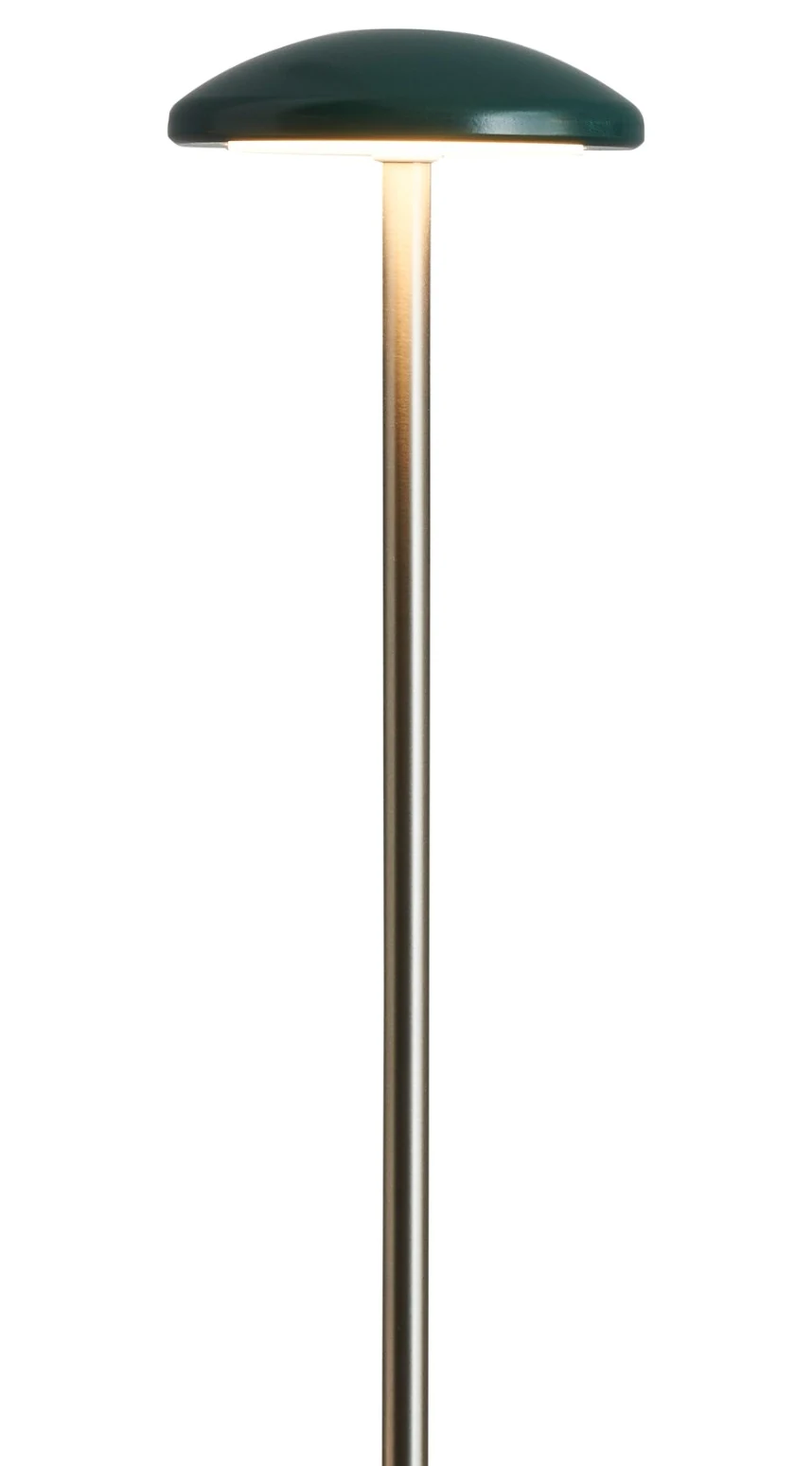
A downward-spreading head lights a circle on the ground whose radius grows with the height of the head. That gives a simple layout rule: space the poles at roughly three to four times the head height for a continuous carpet, and at five to six times if you are happy with a rhythm of pools and shadow between them — which is usually the more beautiful answer. A 530 mm Acorn every 2–2.5 m draws a soft dotted line; a 920 mm Lily every 3–3.5 m covers a wider path in overlapping washes. Put the poles on one side of the path only, on the planting side, so the walking surface stays clear and the row reads as an edge rather than a corridor.
Choose the head by the path
Narrow paths through planting want the smallest possible head so the fitting disappears by day: Acorn's Ø 50 mm dome or, for the lightest touch, a Bloom sphere or a Reed stalk that simply marks the line. Wider paved walks and terrace edges want the broader wash of a Lily saucer or a Vane blade bollard, whose horizontal head lays light down one side only, keeping the planting behind it dark. Where the path meets a wall or a hedge, a Nib post with its single side window throws a soft scallop onto the surface beside it and shows nothing from the far side. Steps take a pole at the top and bottom of the flight, never in the middle of it, so the risers are lit in relief.
Keep the source below the eye
The rule that decides whether a path feels calm or glaring is simple: a seated person on the terrace and a walking person on the path must not see a bare source. A hooded head at 500–900 mm, with the LED entirely under the cap, satisfies it by construction. Open-glass bollards at a metre or more do not, however low their output. Where you want the glow of glass — a Wick column, a Berry sphere — treat it as a marker rather than the main path light, and let a hooded pole do the work on the surface.
Wire it as one low-voltage run
The slim pole family runs on 24 V DC, protection class III, IP65. Lay one cable along the planting side of the path, size the driver for the whole run with a margin for the poles you will add when the beds grow in, and keep the driver in a dry, accessible enclosure near the house. One driver, one 3000 K colour temperature, one matt nickel stem finish: the path reads as a single gesture, and every pole on it can be moved or added to with garden tools rather than an electrician.