In every other room you choose a fixture by how it looks and what it does to the space. In a bathroom you start with a number on the datasheet: the IP code. Steam, splashes and condensation reach places you would not expect, and a fitting that is perfectly safe in a corridor has no business over a shower. Get the protection class right first; the design follows inside what is left.
What the IP code says
IP is followed by two digits. The first is protection against solid objects and dust, the second against water. For bathrooms the second digit is the one that matters: 4 means protected against splashing from any direction, 5 against water jets, 7 against temporary immersion. So IP44 is splash-proof, IP65 is dust-tight and jet-proof. IP20 — the class of most interior fixtures — has no water protection at all and belongs only in the dry part of the room.
The zones, in plain terms
Electrical standards divide a bathroom into zones by distance from water. Inside the bath or the shower tray is zone 0: only low-voltage fittings rated for immersion. The space above the bath or shower up to 2.25 m is zone 1: at least splash protection, and IP65 wherever a shower head can aim water at the fitting. A band 60 cm wide around the bath, shower and basin is zone 2: IP44 as a minimum. Beyond that, ordinary fixtures are allowed, though in a small steamy bathroom IP44 everywhere is the sensible choice. The exact requirement is set by local regulations and your electrician, who should confirm the zones on site.
Ceiling: splash-proof spots
For the general layer, use recessed spots rated for the zone they sit in. Nova is IP44 at 12 W with a Ø 55 mm cut-out, offered in 15°, 24°, 36° and 50° optics — 36° or 50° for the general wash, a narrower beam for a niche or a feature wall. Array is rated IP44/65 in its 3000 K and 4000 K versions, with a Ø 48 mm cut-out. Where the ceiling is concrete and nothing can be recessed, the Vector surface spot is an IP44 cylinder only Ø 38 × 99 mm. Keep spots off the centreline of the mirror: light from directly above puts shadows under the eyes.
The mirror: light the face, not the glass
Shaving and make-up need even light on the face from the front. The best arrangement is a light on each side of the mirror at face height — the centre about 1.6 m above the floor — so the two sides cancel each other's shadows. A single light above the mirror is the second choice; a ceiling spot behind your head is the worst. Ask for CRI ≥90 here above all, and choose 3000 K for a warm bathroom or 4000 K if you want the mirror to show colours as they look in daylight.
Wall and low-level light
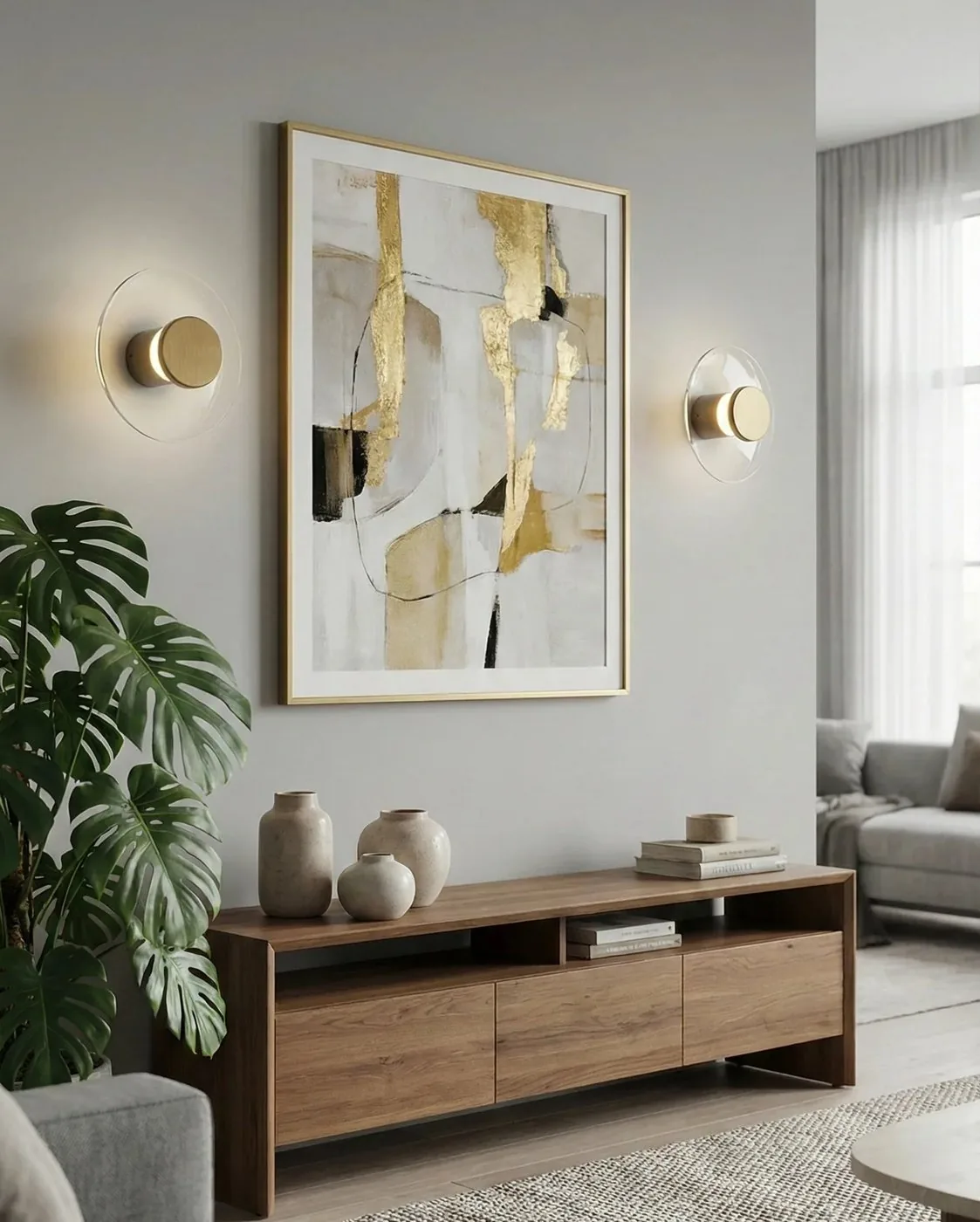
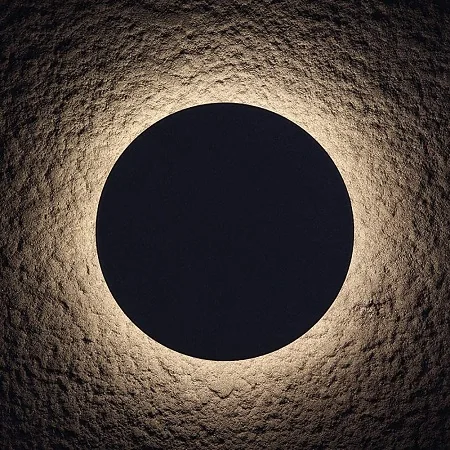
A wall light rated for wet rooms lets you carry the language of the rest of the house into the bathroom. Umbra is an IP65 disc, Ø 140 × 50 mm and 7.2 W, that throws a halo onto the wall around it; Iris is IP55 at 10 W. For the night, a low-level light near the floor is worth its own circuit: the Notch step light is IP65, 3 W, in a 50 × 50 mm face, and gives enough to find your way without waking up fully.
Before the tiles go on
Fix the position of every point while the walls are open — the mirror lights especially, because their height depends on the mirror and the basin, not on the room. Run the bathroom on at least two circuits: mirror and general. Keep drivers outside the wet zones, in an accessible dry place. And check each fixture's datasheet for the IP class of the exact version you are ordering — some families carry different classes in different colour temperatures, and the class printed on the product page is the one that counts.