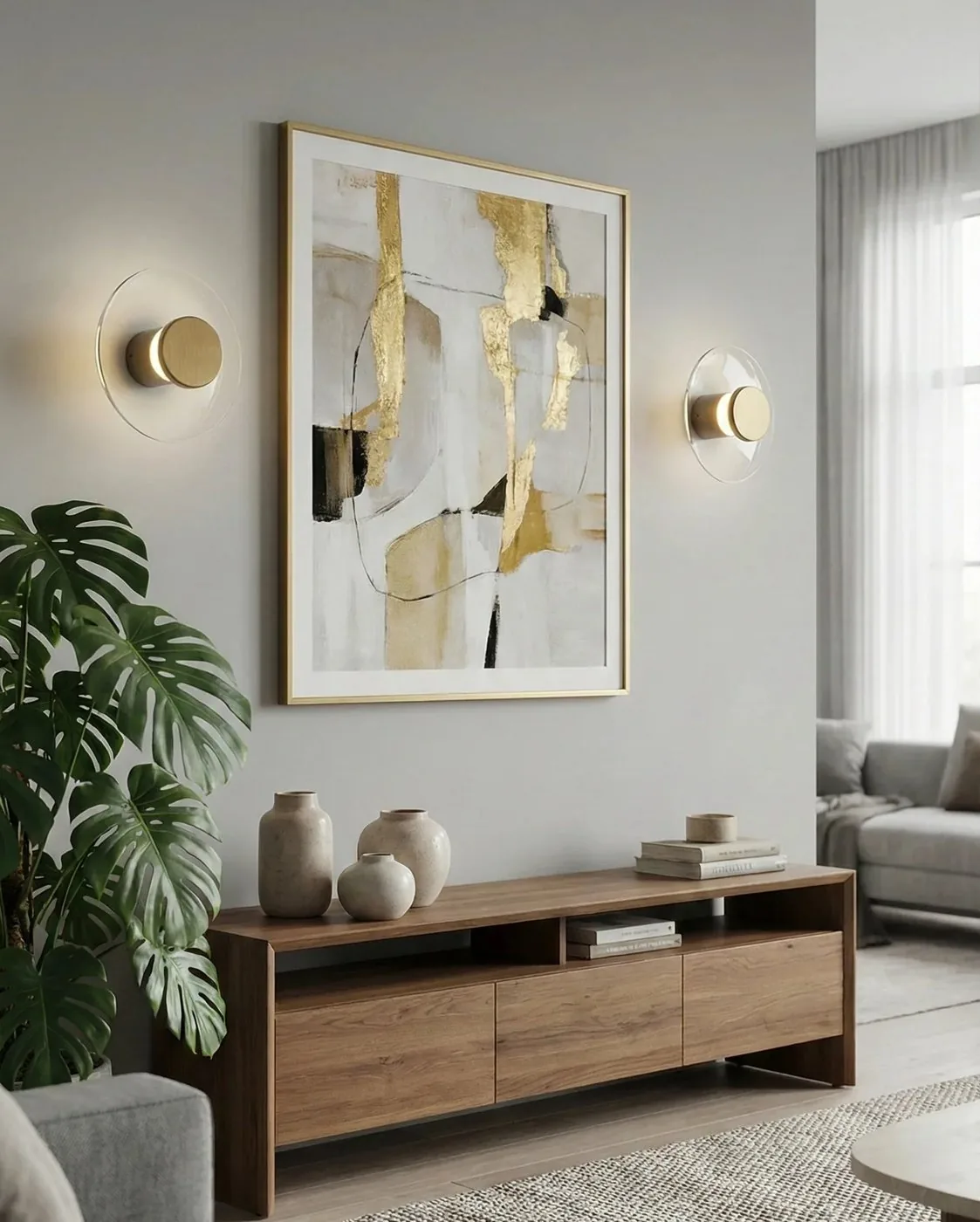
The living room is the hardest room in a house to light because it has no single job. In one evening it hosts a dinner, a film, a child's homework and a quiet hour with a book — and the classic answer, one bright fitting in the middle of the ceiling, is wrong for all four. A living room that works is lit in layers on separate switches, so the room can be re-tuned without moving a lamp.
Layer one: a calm ambient base
The base layer should fill the room without announcing itself. A wide, shallow ceiling fixture does it in one point: the Lens Ceiling Light is a Ø 400 mm glass disc only 70 mm deep, 21 W and 1,800 lm at 3000 K with a UGR below 19 — enough on its own for a 15 to 20 m² room on an ordinary evening. Where the ceiling is suspended, four to six recessed spots with 36° optics do the same job more quietly; set them 1.0–1.2 m apart and keep them away from the centre of the seating so nobody sits directly under one.
Layer two: accent on what you want seen
Accent light is what makes a room look designed. Pick two or three things — a painting, a bookshelf, a plant, a textured wall — and give each its own narrow beam of 15° to 24° from the ceiling. The rule of thumb is three to one: the object should be about three times brighter than the wall around it. For a whole wall of art or a stone surface, a wall-washer spot such as Veil spreads light evenly from top to bottom from a Ø 57 mm cut-out, with a UGR below 12.
Layer three: light on the walls
A room feels bright when its walls are bright, not its floor. Two or three wall lights at eye level do more for the sense of space than doubling the ceiling output. A backlit glass disc like the Lens Wall Light — Ø 350 mm, 9 W, 760 lm — carries a wall above a sofa or a console by itself. Put this layer on its own circuit: late in the evening it is often the only one you want.
Layer four: task light where people sit
Reading needs light on the page, from beside or behind the shoulder, not from the ceiling. A pendant over a side table, a floor lamp or an adjustable desk lamp belongs next to every seat that is used for reading. The Crane table lamp reaches 700 mm on an articulated arm with a touch dimmer, so the same lamp serves a desk corner and an armchair. Over a dining table inside the living room, hang the pendant so its lower edge is 70–80 cm above the tabletop; a Ø 350 mm Plisse pendant at 2700 K suits a table for four.
Television: what to switch off
Glare on the screen comes from sources in front of it; eye strain comes from a bright screen in a dark room. So for a film, switch off everything facing the screen and leave a low light behind or beside it — a dimmed wall light or a lamp on the console. Never place a recessed spot above the screen wall where it can reflect, and keep the spots over the sofa on a separate switch from those near the television.
Colour temperature and dimming
Use 2700 K or 3000 K throughout and do not mix them within one sightline; warm light at low level is what makes an evening room feel comfortable. Ask for CRI ≥90 so wood, textiles and skin look right. Then dim: a living room at full output is a showroom. Most QAVUN ceiling and pendant fixtures are offered with On/Off or DALI control as an order option — decide which before the cables are pulled, because the choice changes the wiring.
A sample scheme for 25 m²
One Lens Ceiling Light or six 36° recessed spots for the base; two 24° spots on a painting and a shelf; two wall lights on the long wall; a table lamp by the reading chair; a pendant over the dining table. Five circuits, or three with dimming, give you every evening the room will ever need. Send us the furniture plan and we will place the points and run the DIALux check before the ceiling closes.