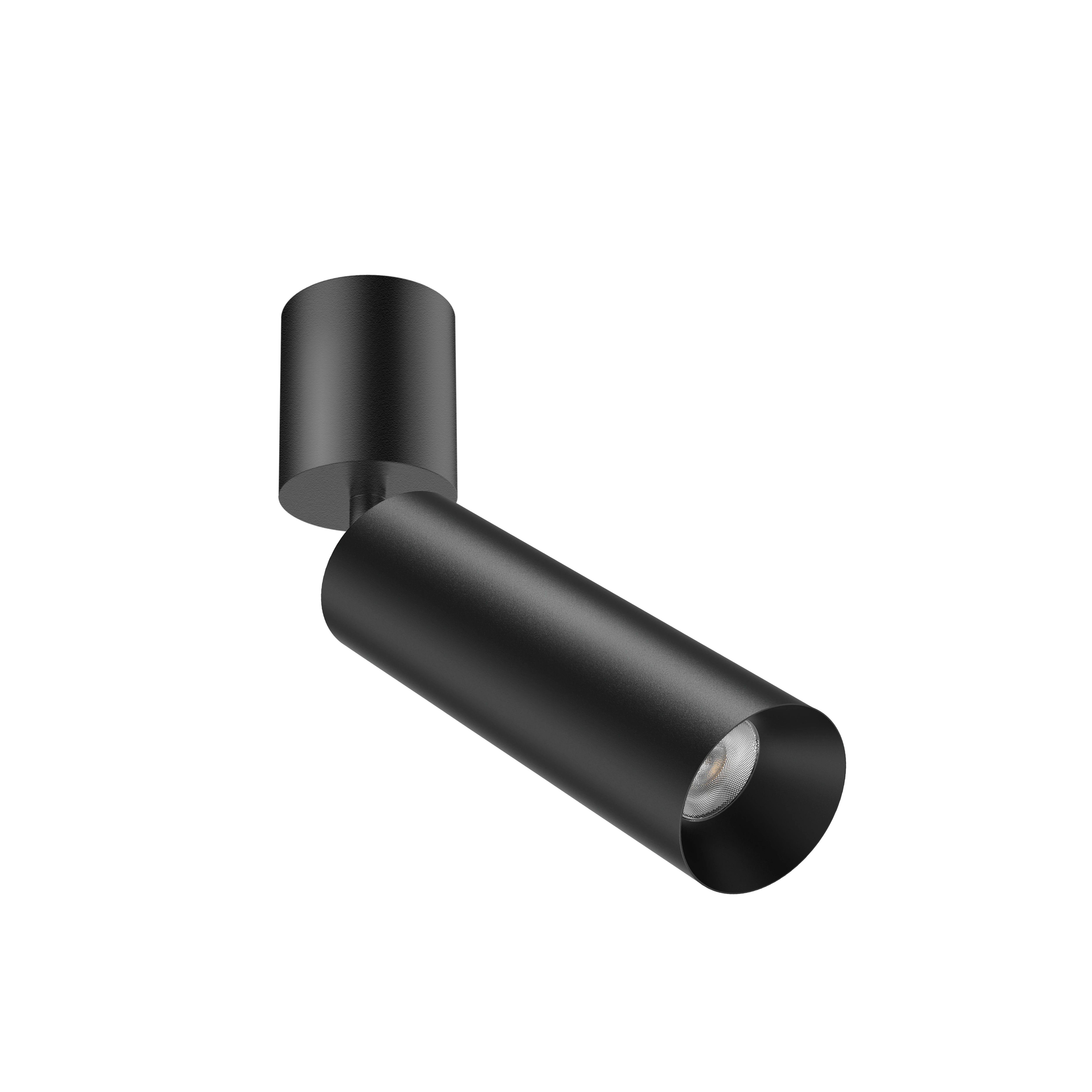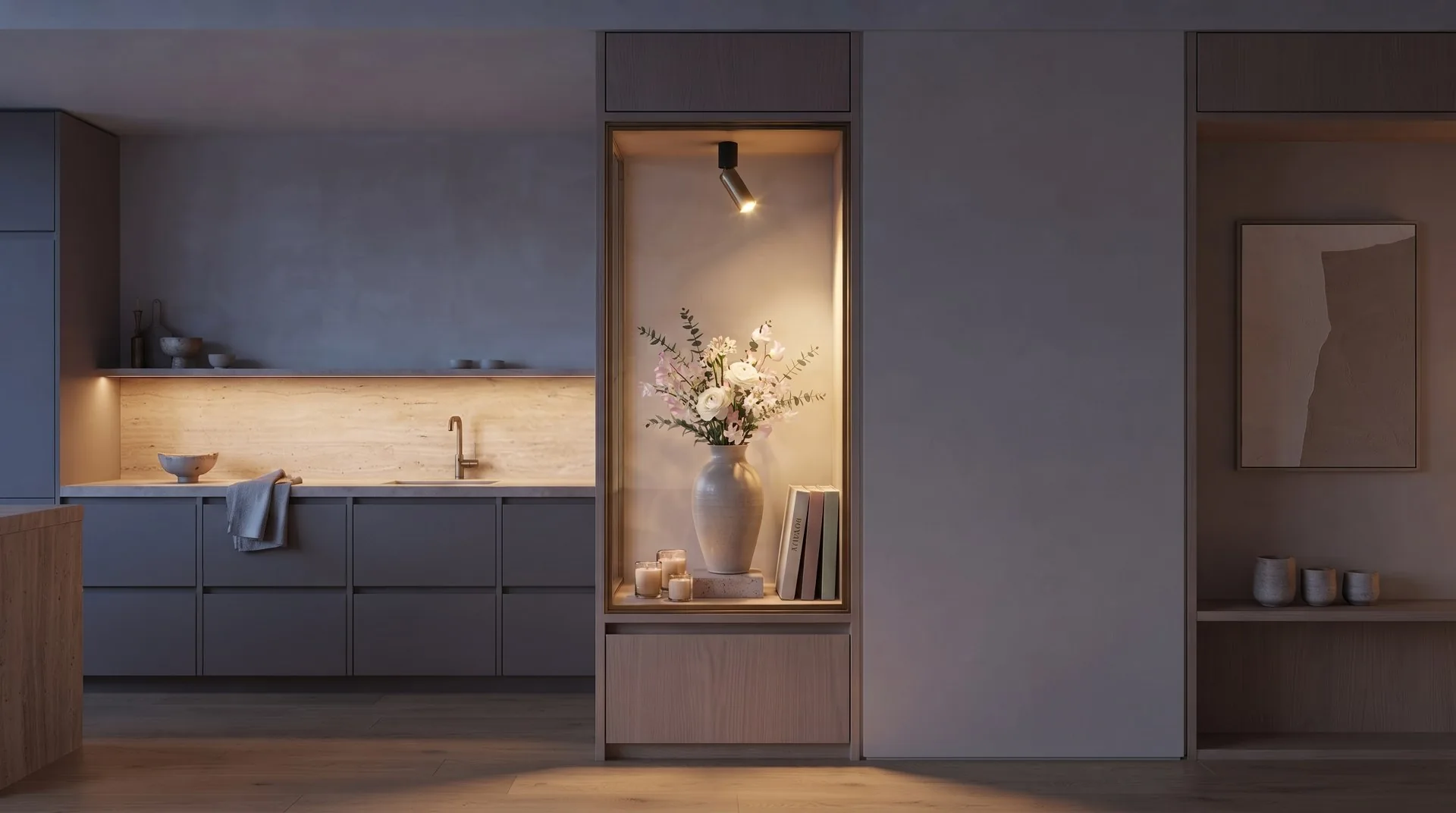
A recessed spot needs a ceiling void, and many rooms do not have one: an exposed concrete slab, a vaulted timber roof, a listed building where the ceiling cannot be cut, or a renovation where nobody wants to drop the ceiling by ten centimetres. A surface-mounted spot sits on the ceiling instead of in it. It gives the same accent and ambient light, but the body stays visible, so the choice is as much about how the fixture looks as about the light it gives.
When surface mounting is the right answer
Choose surface spots when the ceiling cannot be opened, when the void is too shallow for the recessed fixture you want, or when the cylinder itself is part of the design — in a kitchen, a gallery wall or a loft the row of bodies reads as a line on the ceiling. If the ceiling is plasterboard with a deep void and the goal is a quiet ceiling, recessed is still the better tool; our recessed guide covers that route.
Size: how much body you want to see
Surface fixtures differ mostly in how much they show. The Vector spot is the slimmest in the QAVUN range at Ø 38 × H 99 mm. The Star spot is a fuller cylinder at Ø 62 × H 105 mm. The Arte surface downlights are wide and low: Ø 85 mm with a height of 75 mm for Arte Bone and 89 mm for Arte Line. The GU10 bodies take a replaceable lamp: Holo Surface Spot 11 and 18 are Ø 59 × H 79 mm, Holo 19 is Ø 80 × H 80 mm and the Retro spot is Ø 55 × H 100 mm. On a low ceiling a 100 mm cylinder is noticeable; on a 3 m ceiling it almost disappears.
Beam angle and adjustability
The same rule as for recessed spots applies: the lit circle grows with ceiling height and beam angle. At 2.7 m to the floor a 24° beam lights a circle of about 1.15 m, 36° about 1.75 m and 50° about 2.5 m. Vector is offered in 16°, 24°, 36° and 50° and is an adjustable spot, so it can be aimed at a painting or a worktop after installation. Star has a 24° beam. Arte Bone spreads 38° and Arte Line 110°, which makes them general-light fixtures rather than accent spots. With the GU10 bodies the beam, power and colour temperature come from the lamp you fit.
Glare, colour and control
A visible body does not have to mean a glaring one. Vector reaches UGR <10 with the 16° and 24° optics, <14 at 36° and <22 at 50°; Star is rated UGR <12. All of the integrated LED surface spots in the range have CRI ≥90. Star and Arte are 3000K (Star 2700K on request), Vector is 3000K or 4000K as an order option, and Star and Vector are both offered On/Off or with DALI dimming. Vector is IP44, so it also suits a bathroom outside the wet zones or a covered terrace; the others are IP20 for dry interiors.
Power and light output
Vector draws 8 W and measures between 516 and 554 lm depending on the beam. Star draws 10 W and measures 582 lm. The Arte surface downlights draw 7 W for 770 lm. Those figures are enough to plan a room: a 12 m² kitchen at around 300 lx on the worktop needs roughly 7,000 lm leaving the fixtures if they are the only light, which is why a surface-spot kitchen usually combines spots over the worktop with a linear or pendant fixture over the island. Send us the plan and the ceiling section, and we will check the layout in DIALux before anything is drilled.