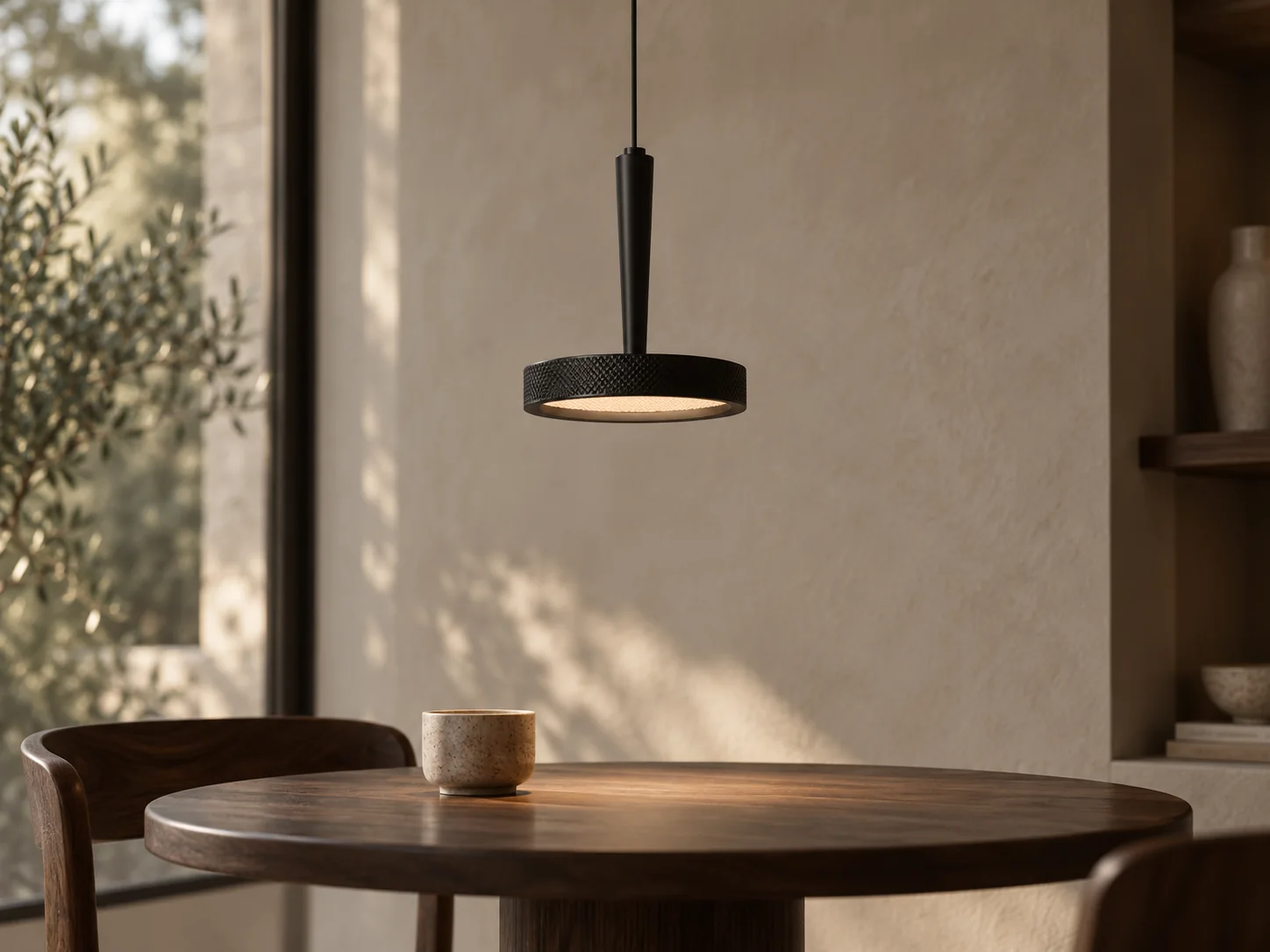
"Chandelier" used to mean one thing: a crystal cluster in the middle of the living-room ceiling. Today the word covers a whole family of suspended fixtures — a single slim tube over a side table, a 1.2 m bar over a kitchen island, a pleated disc over the dining table, three cylinders at different heights in a stairwell. Choosing well is less about taste than about three measurements: the height of the ceiling, the size of what sits beneath the light, and how much light the room actually needs.
This guide walks through the pendant and chandelier models we see specified most often in Turkish homes and hotels, room by room, with the sizing rules we use ourselves. Every model named below is a QAVUN product with a datasheet, a dimensioned drawing and a 3D file on its product page.
What to check before choosing a pendant
Six things decide whether a pendant works in a room. Settle them before you look at a single photograph:
- Ceiling height: below 2.6 m, keep the body under 150 mm tall or use a disc; above 3 m, a long drop or a vertical form fills the volume.
- What sits beneath it: a pendant is sized to the table, island or seating group below, not to the room.
- Light task: a dining table wants light on the surface; a living room wants ambient light that does not glare from the sofa.
- Colour temperature: 2700 K for living and dining, 3000 K for kitchens and hallways; never mix two temperatures in one sightline.
- Finish: matte white and sand black disappear; brass, bronze and champagne gold become the room's jewellery — decide which role the fixture plays.
- Dimming: a dining pendant is used at full output for ten minutes and at half for two hours; specify a dimmable driver.
Living-room pendant models
The living room is the one place where the pendant may be the object. A pleated or fluted shade such as Plisse, Ø 350 mm in ivory or blue, reads as a soft lantern over a coffee table and throws a wide, even glow. A ring — Delta at Ø 408 mm or Loop at 588 mm — hovers over the seating group without blocking the view across the room. Where the ceiling is low, a glass disc such as the Lens pendant keeps the body to 50 mm and lets the light do the work.
Hang the living-room pendant so its lowest point sits at 2.1–2.2 m from the floor if people walk beneath it, or at 1.6–1.7 m if it hangs over a table nobody passes. Keep it dimmable: at full output it is a statement, at 30 % it is the evening.
Dining-table pendant: size and hanging height
Over a table the rules are precise, because the fixture is seen from a seated eye every evening. The pendant's width should be one half to two thirds of the table's width; a 900 mm wide table takes a Ø 450–600 mm form or a linear bar that stops 300 mm short of each end. For a long table, a linear pendant such as the 1200 mm Linea bar or a row of three small cylinders — Lino at Ø 45 mm, Aura at 135 mm — lights the whole length without a single heavy object in the middle.
The lower edge sits 750–900 mm above the table top. Lower looks intimate but blocks faces; higher spreads the light but shows the source. Centre the pendant on the table, not on the room — in most dining rooms those are two different points.
- Width: ½ to ⅔ of the table width.
- Height above the table: 750–900 mm to the lowest point.
- Linear pendants: 300 mm shorter than the table at each end.
- Two or three small pendants: spaced at 600–800 mm, all at the same height.
Kitchen island and bar: linear pendants
An island is a work surface first, so the pendant must put light on the counter without glare at eye level. A linear bar with an up/down distribution — Linea gives 1200 mm of light in a 23 mm body, Ridge a shorter 220 mm profile in champagne gold — lights the worktop and softens the ceiling at once. Hang it at 800–850 mm above the counter, and choose 3000 K rather than 2700 K: food and stone read truer in the slightly cooler white.
Hallway, entrance and stairwell
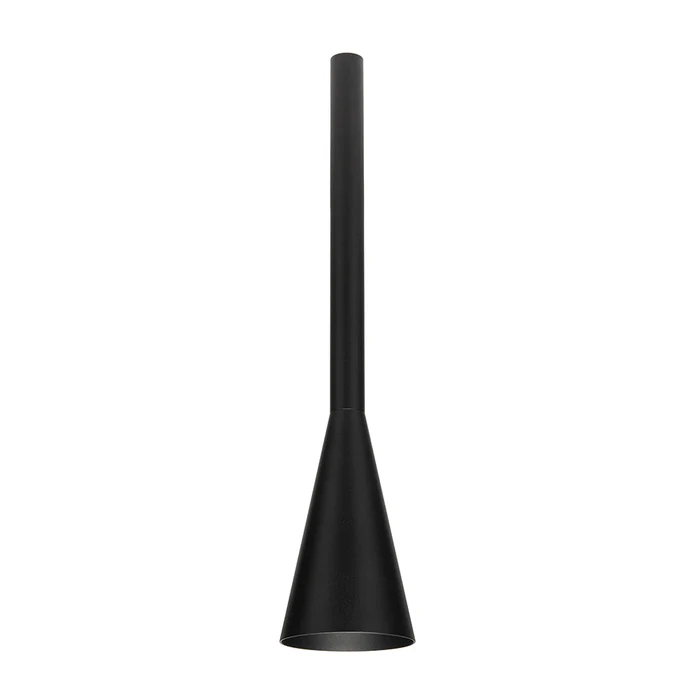
Circulation spaces do not need a chandelier; they need a vertical gesture. In a stairwell, three Lino tubes or three Avatar cones at staggered drops of 1.0, 1.6 and 2.2 m make the height legible from every landing. In an entrance, a single disc or a small ring at 2.2 m marks the threshold without competing with the room beyond. Keep the output modest; the hallway is a passage, not a destination.
Bedroom pendant models
The bedroom pendant is the one most often chosen wrong: a bright centre fixture seen from the pillow. Use a small, warm, dimmable pendant on each side of the bed instead — Lino at Ø 45 mm or a Petal at 2700 K, hung at 500–600 mm above the bedside table — and leave the centre of the ceiling empty or give it a shallow disc. Lower colour temperature here, 2700 K, and nothing brighter than the reading light.
Which pendant model suits which style?
A short matching table for the interiors we see most often:
| Model | Style it suits | Where | Size · colour |
|---|---|---|---|
| Plisse pleated pendant | Soft modern, Scandinavian, boutique hotel | Living room, dining table | Ø 350 mm · 2700 K · ivory, blue |
| Linea bar pendant | Minimal, contemporary kitchen | Island, long table, office | 1200 mm · 2700–5700 K · 5 finishes |
| Aura pendant | Industrial-contemporary | Dining, bar, stairwell cluster | 135 × 135 × 100 mm · 2700–5000 K |
| Lino tube pendant | Architectural minimal | Bedside, stairwell, side table | Ø 45 × 350 mm · 3000 K |
| Lens disc pendant | Modern glass, low ceilings | Dining, entrance | Ø 320 mm · 3000 K · bronze, brass |
| Delta / Loop ring | Contemporary, open plan | Seating group, reception | 408–588 mm · 2700–5700 K |
| Avatar cone pendant | Warm modern, fabric and metal | Lounge, hotel room | Ø 75 × 350 mm · 3000 / 4000 K |
What moves the price of a pendant
Four things: the light source (an integrated, high-CRI LED module costs more than a lamp socket and lasts longer), the driver (dimmable and DALI drivers add to the price), the body (machined aluminium and glass over pressed steel) and the finish (anodised or powder-coated matte finishes over paint). A pendant that will hang for fifteen years over a dining table should be chosen on the first two; the fixture is seen, but the light is lived with.
QAVUN's prices are shown to approved professional accounts on each product page, and retail prices in Turkish lira are on our aydinlatmaconcept.com store.
Pendant trends for 2026
What we see in this year's projects, in order of how often it is asked for:
- Linear over round: a single long bar over the table instead of a central cluster.
- Tunable white: 2700–5700 K on one fixture, warm at dinner, neutral at breakfast.
- Clusters of small pendants at staggered heights in stairwells and double-height rooms.
- Fabric, pleats and paper-like shades that soften the LED source.
- Matte finishes — sand white, sand black, bronze — over chrome and polished brass.
- Dimming by default: no pendant specified without a dimmable driver.
Seven questions before you buy
- How high is the ceiling, and will anyone walk beneath the fixture?
- What exactly sits below it, and how wide is it?
- Is this the room's main light, or a layer over other lighting?
- Which colour temperature do the other fixtures in sight use?
- Is the driver dimmable, and does it match the dimmer on the wall?
- Can the drop be adjusted on site, and how long is the maximum cable?
- Is there a datasheet with a dimensioned drawing and a 3D file for the project?
Why QAVUN
Every pendant on this page has a product page with a Turkish datasheet, a dimensioned drawing, a 3D model and, where it exists, an IES file — the material an architect needs to write it into a specification. In-stock items leave Ankara within 1–2 business days, every fixture carries a 3-year warranty, and the showroom in Hacı Bayram shows them hanging at real heights over a real table.
See the pendant family in the catalogue, or book a showroom visit and bring the plan.