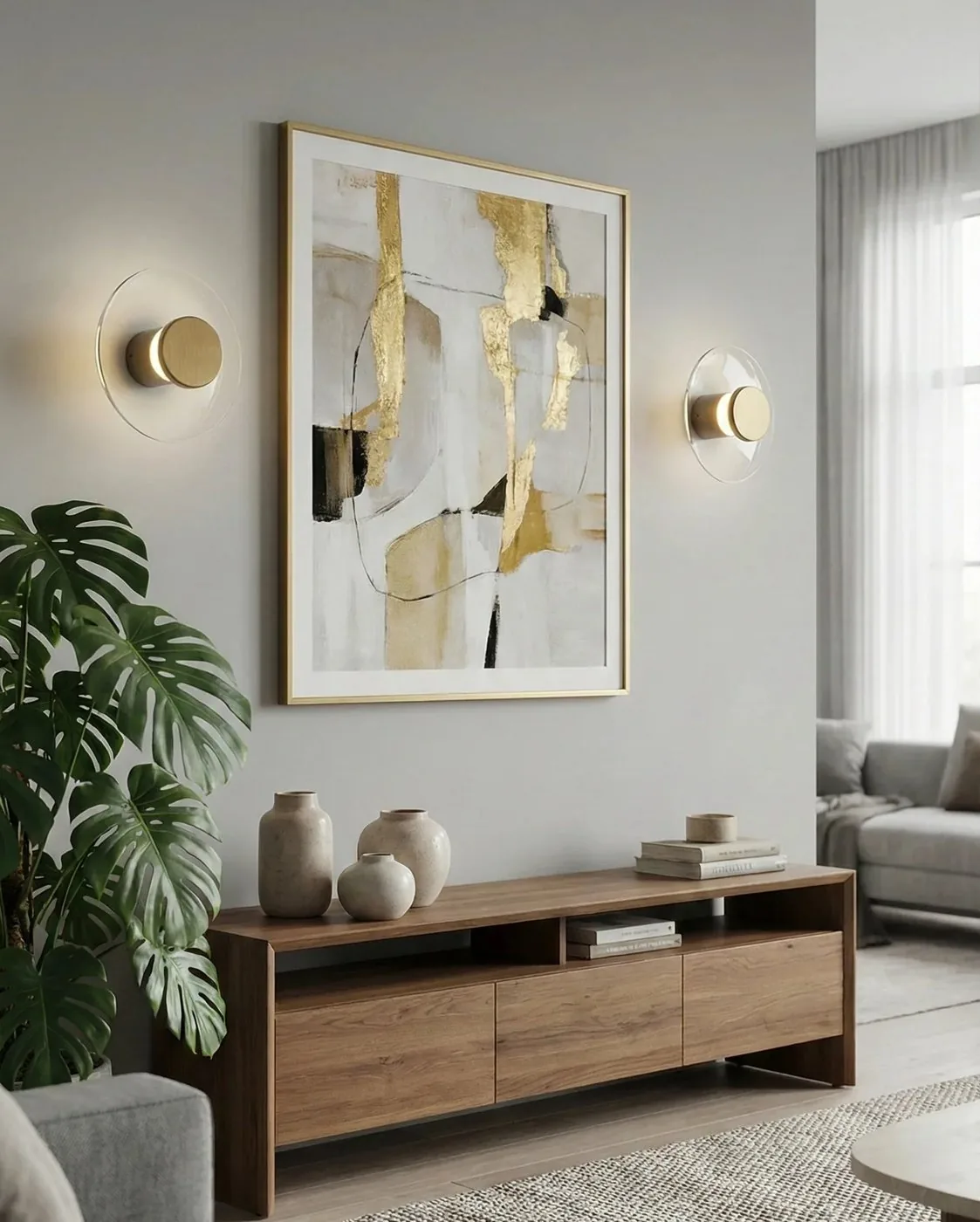
A wall light is the fixture people decide last and regret first, because its position is fixed by a cable that was buried in the plaster months earlier. Get the height wrong by twenty centimetres and it either glares into the eye or sits stranded above the furniture. The good news is that the rules are few, and they are about people's eye level rather than about the fitting.
Mounting height: the eye-level rule
In a living room or a corridor, set the centre of the fitting 1.5 to 1.7 m above the finished floor: at or just above the standing eye, so the wall takes the light and the source stays out of direct view. Beside a bed the reference is the seated eye, so the centre drops to 1.1–1.3 m, within arm's reach of the pillow. On a staircase, measure the height from the nosing of the step below the fitting, not from the landing. With ceilings above 3 m you may go up to 1.8–1.9 m, but not higher — a wall light near the ceiling is a ceiling light in the wrong place.
Spacing along a corridor or a long wall
A rhythm of 2 to 2.5 m between centres reads as continuous in a corridor; closer than that turns the wall into a row of dots, wider leaves dark gaps. Start from the features, not from the corner: centre a fitting on a door-free stretch, flank a mirror or a console with a pair, and let the remaining positions fall from that. In a living room, two or three wall lights are a layer of their own — they should be on a separate circuit from the ceiling so the room can run on them alone in the evening.
Size the fitting to the wall
A large disc needs air around it. The Lens Wall Light is a Ø 350 mm halo-backlit glass disc, 50 mm deep, 9 W and 760 lm at 3000 K: a single one carries a 2 to 3 m stretch of wall above a console or a sofa. The Lens Mini is Ø 150 mm and 7 W, made to work in pairs — either side of a mirror, a bedhead or a doorway. As a rule of thumb, a wall light should be no wider than a third of the furniture beneath it, and a pair should sit 10–20 cm outside the edges of what it frames.
Decide what the light should do to the wall
Wall lights fall into three behaviours. A backlit disc such as Lens throws a soft halo around itself and makes the wall glow; it is ambient light and a focal point at once. An up-and-down blade such as the Vane wall light draws two defined strokes of light with a 36° beam from a body only 135 × 50 × 90 mm; it models the wall and reads as architecture rather than as an object. A directed reading light puts light on a page and nowhere else. Choose the behaviour first — the form follows from it.
Outdoors: check the IP class, then the finish
On a facade, a terrace or beside an entrance, the first filter is the protection class. Vane is rated IP54 and runs at 6 W and 3000 K, so the same fitting can continue from the interior hall out onto the terrace wall — which is the simplest way to make inside and outside read as one house. Interior wall lights such as Lens are IP20 and stay indoors. Under an open sky, mount the fitting so the cable entry faces down or is sealed, and keep the colour temperature identical to the garden lighting.
Plan the cable before the plaster
Every rule above has to be decided while the walls are still open. Mark the centre heights on the bare wall with the furniture layout in hand, pull the cable to exactly that point, and leave a 15–20 cm tail. Decide the control at the same time: wall lights earn their keep on a dimmer or a separate switch. If the building is finished and the cable is in the wrong place, a larger backplate or a disc fitting can cover an offset of a few centimetres — another reason the disc is the forgiving choice in renovation.


