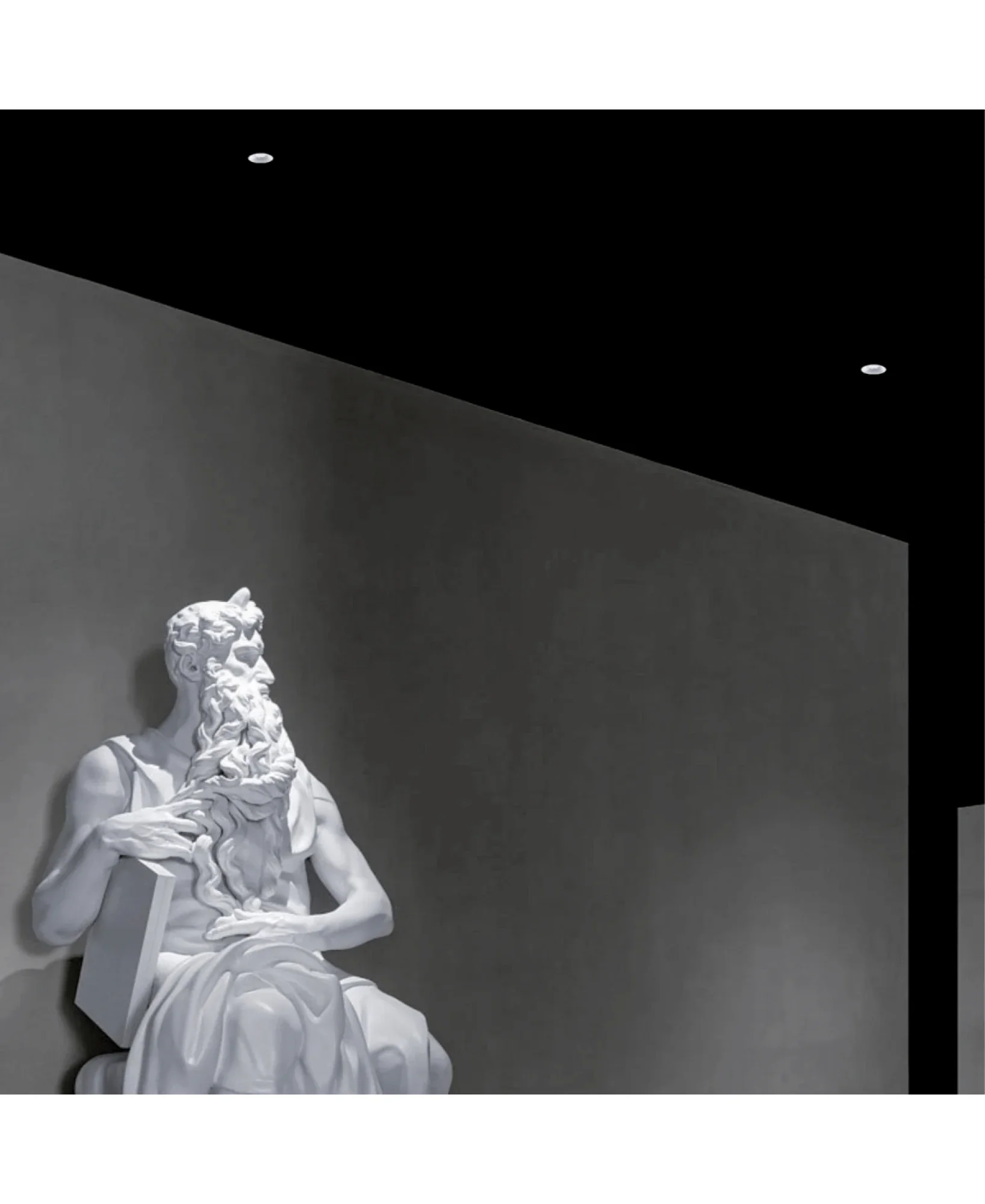
Recessed spots are the most specified fixture in a home and the one most often chosen backwards: people pick a face they like, then discover the hole is the wrong size, the beam is too narrow for the ceiling height, or twelve of them glare straight into the sofa. The order that works is the opposite. Decide the cut-out and the ceiling void first, then the beam, then the count, and only then the finish.
Start with the cut-out and the ceiling void
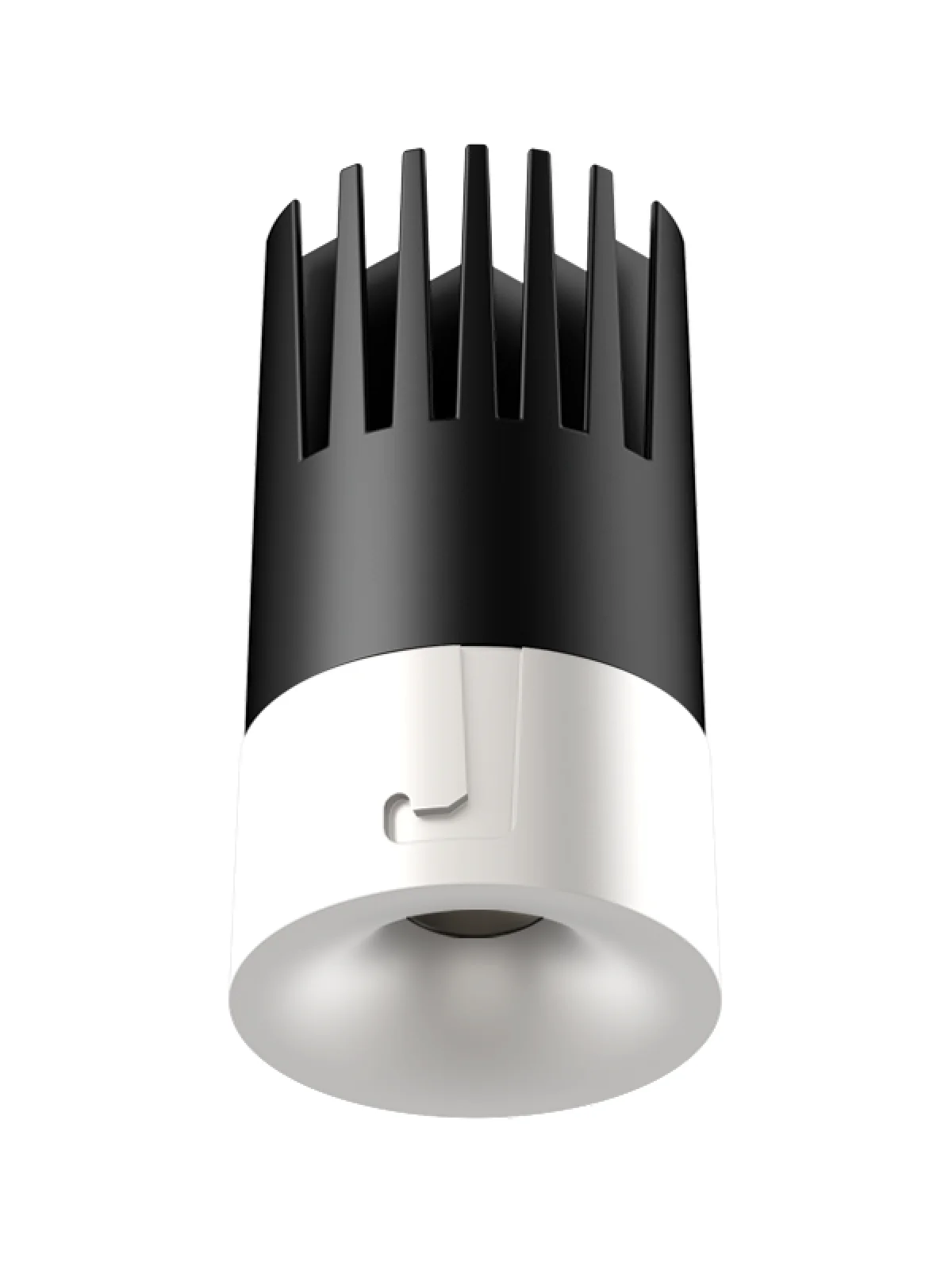
The cut-out diameter is the one number the plasterboard contractor needs, and it cannot be changed after the ceiling is closed. In the QAVUN recessed range it runs from Ø 54 mm for the Vega spot and Ø 55 mm for Nova, through Ø 57 mm for the Veil wall washer and Ø 65 / Ø 75 mm for the two Pin sizes, to Ø 75–76 mm for the GU10 trims (Tilt, Scoop, Holo) and Ø 100 mm for the Air downlight. The second number is the depth above the ceiling: Vega needs 73 mm, Nova recesses 44 mm, a Tilt trim only 40 mm plus the lamp. Measure the void before you fall for a fixture — a 60 mm void rules out half the catalogue.
Pick the beam angle from the ceiling height
A spot lights a circle whose diameter is roughly twice the mounting height times the tangent of half the beam angle. From a 2.7 m ceiling to the floor that is about 1.15 m for a 24° beam, 1.75 m for 36° and 2.5 m for 50°. So 15° and 24° are accent beams — a painting, a vase, a table centre; 36° is the general-purpose beam for living rooms and corridors; 50° and wider is for low ceilings or an even wash. Vega is offered in 24° and 36°, Nova in 15°, 24°, 36° and 50°, so one family can do the accent and the ambient layer with the same face on the ceiling.
How many spots, and how far apart
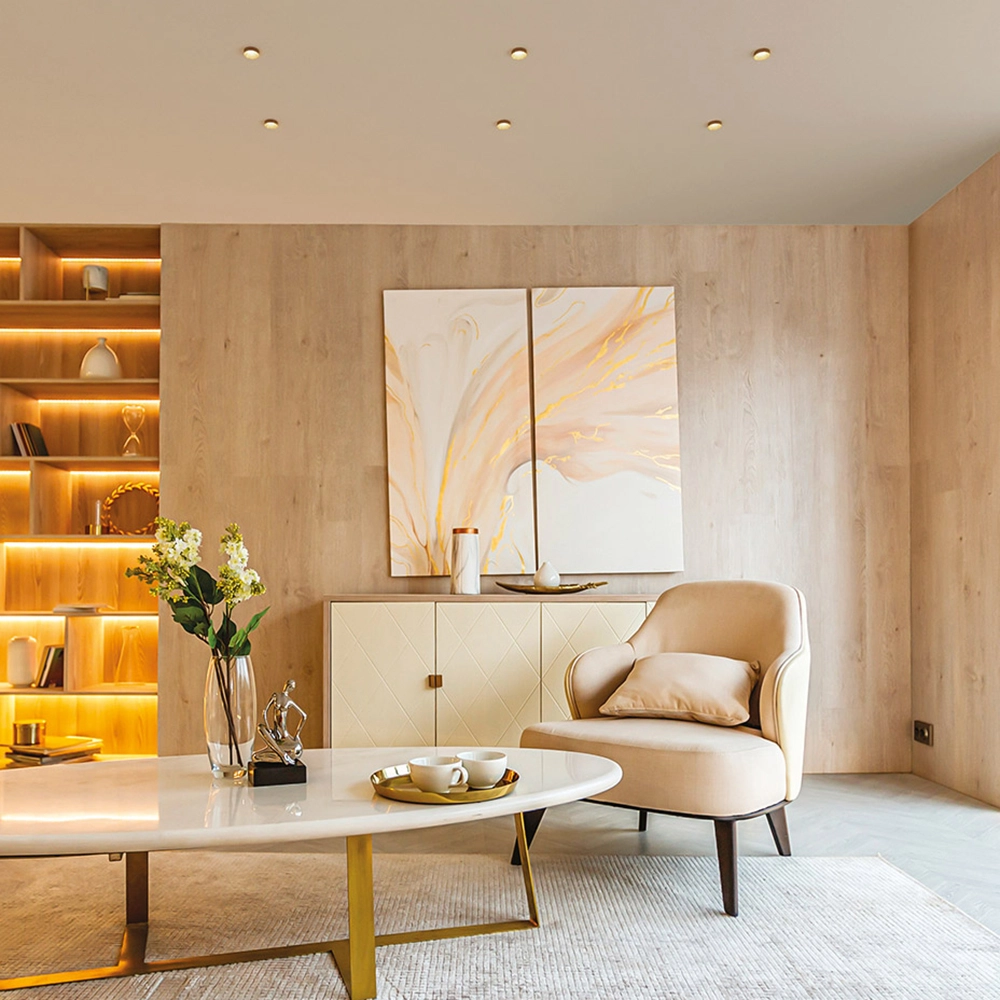
For an even field with 36° beams at 2.7 m, set the spots 1.0 to 1.2 m apart and half that distance from the walls. A quick check on quantity is the lumen method: floor area × target illuminance ÷ 0.5. A 20 m² living room at 150 lx needs about 6,000 lm leaving the fixtures; the Vega spot measures 1,087 lm, so six of them carry the ambient layer and anything beyond that is accent. This is an estimate, not a calculation — reflectances and furniture change it — which is why we run a DIALux study for projects before the ceiling is drawn.
Glare is a specification, not a feeling
What makes a spot comfortable is how deep the source sits behind the opening. That is measured as UGR; offices are usually designed to 19 or below, and a living room deserves better. Vega reaches UGR <13 with the 24° optic and <17 with 36°. Nova runs from <10 at 15° to <20 at 50°. The Pin spot, with its 18 mm aperture, is the calmest of all: <4 at 22° on the 6 W size. If a seated person can see the bright point of the LED from the sofa, no dimmer will fix it — choose the deeper optic.
Integrated LED or a GU10 trim
A GU10 trim such as Tilt, Scoop or Holo is a holder: wattage, colour temperature and beam all come from the lamp you fit, and you can change the lamp yourself in a minute. An integrated spot such as Vega, Nova or Pin has its optics, CRI ≥90 source and driver matched at the factory, which is what gives the defined beam and the low glare figures above. Use GU10 where easy maintenance matters most; use integrated spots wherever the light quality is the point of the room.
Wet rooms and colour temperature
In a bathroom or over a shower, check the IP class on the datasheet before anything else; Nova is rated IP44, while the Pin and Veil spots are IP20 and belong in dry rooms. Keep one colour temperature across everything you can see from one spot in the room — 3000 K is the standard across the range, with 2700 K and 4000 K on request for most families. A warm spot next to a cool one is the most visible mistake a ceiling can make.
A short checklist before you order
Void depth measured. Cut-out diameter given to the ceiling contractor in writing. Beam angle chosen per position, not per room. Spacing drawn at 1.0–1.2 m with half-spacing to the walls. UGR checked for every position visible from a seat. One colour temperature. Dimming decided — On/Off or DALI — before the cable is pulled. Send us the plan and we will check it against the photometric files, or bring it to the Ankara showroom and see the beams side by side.