The kitchen is the one room in a house where light is a tool before it is an atmosphere. You cut, read labels and judge whether food is cooked by its colour, and you do it facing a wall with your back to the room. Most kitchens are lit from the centre of the ceiling, which puts the cook's own shadow exactly on the chopping board. A good kitchen is lit in the opposite order: worktop first, island second, ceiling last.
The worktop: light in front of you, not behind
Task lighting on the counter wants 300 to 500 lx, several times what a living room needs. The position matters more than the wattage: a ceiling spot must sit above the front edge of the worktop — about 60 cm out from the wall — so the light falls in front of your hands rather than on your shoulders. With wall cabinets, a linear light under the cabinet does the job better than anything on the ceiling. Use a wide beam here, 36° or more, so the pools overlap along the whole run and the splashback is lit evenly.
The island: pendants at the right height
An island or a breakfast bar is lit from pendants whose lower edge hangs 70 to 80 cm above the worktop — low enough to light the surface, high enough that two people can see each other across it. Slim cylinders work in a row: the Lino pendant is Ø 45 × 350 mm, 10 W, with 24° or 36° optics and UGR down to <9, so three of them at 60–70 cm centres light a 2 m island without a visible source. Where the island is also the dining table, a single ring does both jobs: the Delta ring pendant sends 2,168 lm down onto the table and 1,055 lm up onto the ceiling, measured, from a 408 mm frame.
The ceiling: general light that stays quiet
Once the worktop and the island are lit, the ceiling only has to fill the room. Wide-beam downlights do it with few fixtures: the Air Downlight 15 W gives 1,200 lm at 110° from a 36 mm deep body in a Ø 100 mm cut-out, and its colour temperature is switchable between 3000, 4000 and 6500 K on the fixture. Lay them on a grid over the circulation zone, not over the cabinets, and keep them on their own circuit so the kitchen can drop to island light alone when the cooking is done.
A track where the layout may change
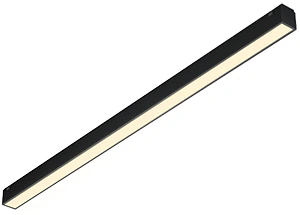
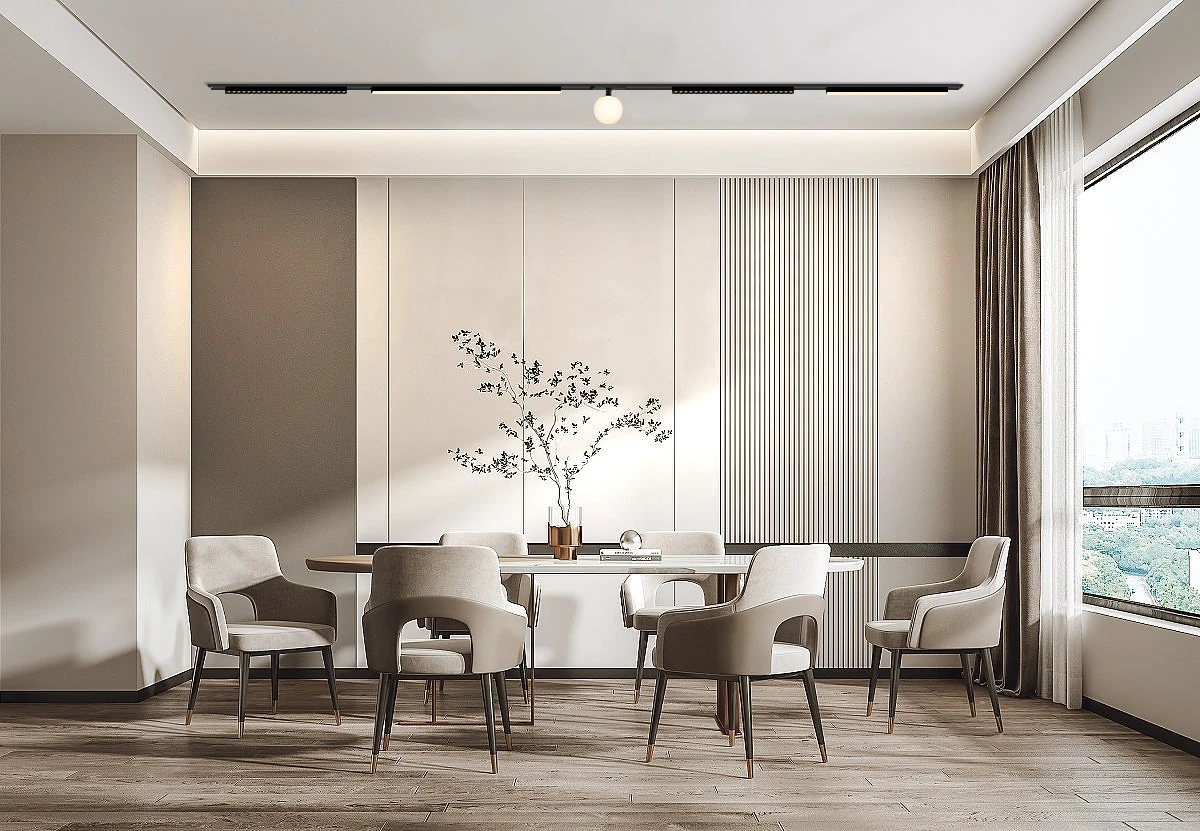
Kitchens get rearranged — an island moves, a table arrives. A 48 V magnetic track lets the light follow: heads snap on and off the rail without tools. A Trace Linear 20 module is 485 mm long, 24 W, 110°, about 1,800 lm, and is offered in 3000, 4000 and 5000 K; combined with spot heads on the same track it covers general and task light from one line in the ceiling. Run the track parallel to the worktop, above its front edge, and the shadow problem is solved along the whole counter.
Colour temperature and colour rendering
Food is the hardest thing in a house to light well, because we judge it by colour. Ask for CRI ≥90 on every source that lights the worktop and the table — at CRI 80, red meat and tomatoes go dull. For colour temperature, 3000 K suits a kitchen that opens onto the living room; 4000 K gives a crisper, more workmanlike light in a closed kitchen. Whichever you choose, hold it across all three layers. A tunable pendant such as Delta, adjustable from 2700 to 5700 K, lets the same island work for breakfast and for dinner.
Three circuits, and one for the evening
Wire the three layers separately: worktop, island, ceiling. Add dimming to the island at least. That gives four useful scenes from three switches — everything on for cooking, worktop and island for a quick meal, island alone for the evening, and a dimmed ceiling for walking through at night. Decide On/Off or DALI before the cables are pulled; it is the one choice that cannot be changed from the showroom afterwards. Bring the kitchen plan to us and we will mark the positions on it.