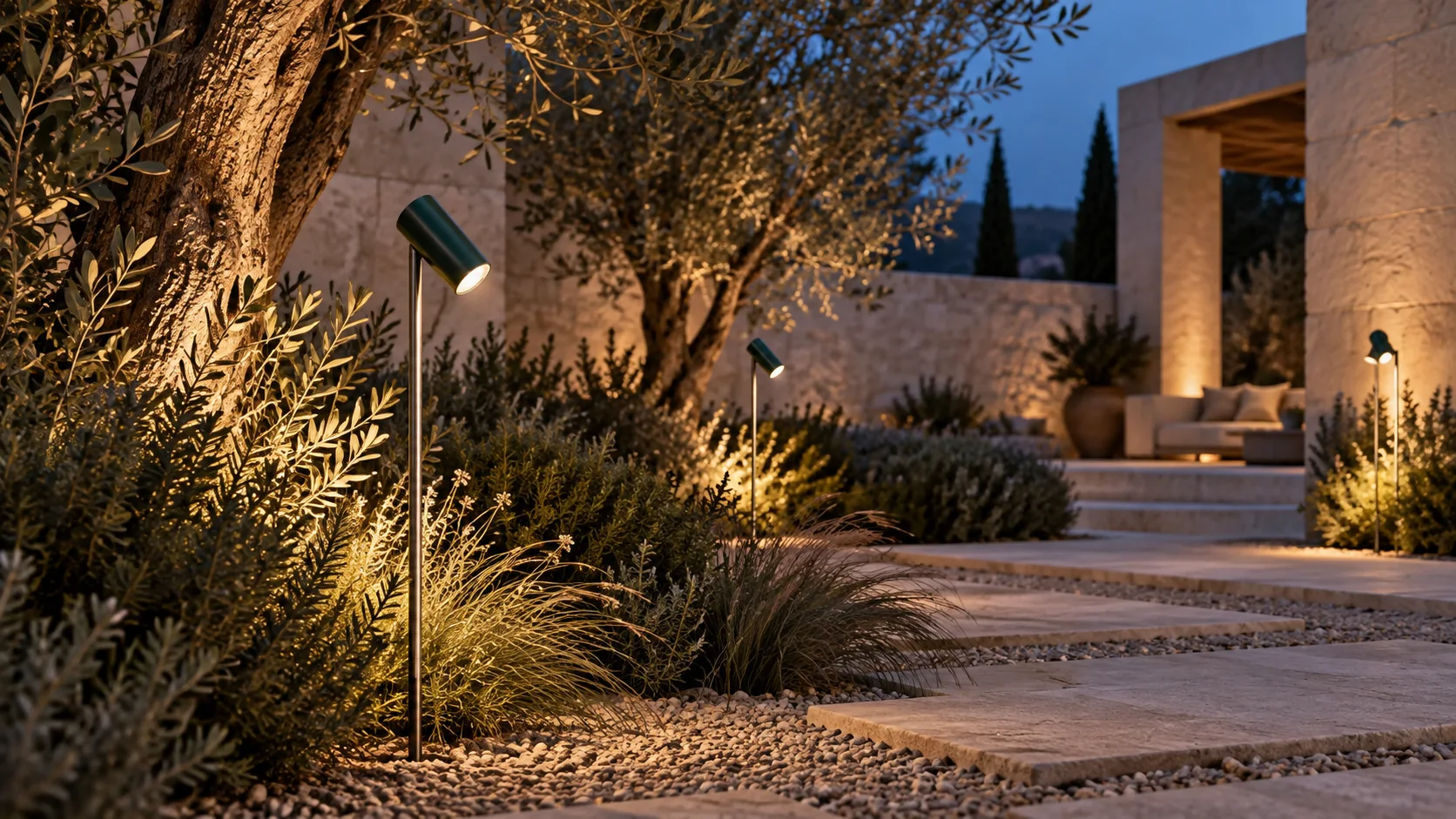
A villa garden is looked at far more than it is walked in. On most evenings it is a picture seen through glass from the living room, and the lighting scheme should be designed for that view first. A single security floodlight turns the glass into a black mirror; a scattering of bright bollards turns it into a row of dots. What makes the garden appear through the window is a composition of layers, each at a low level, arranged in depth. This is the plan we recommend for private gardens, terraces and small courtyards.
Layer one: the path
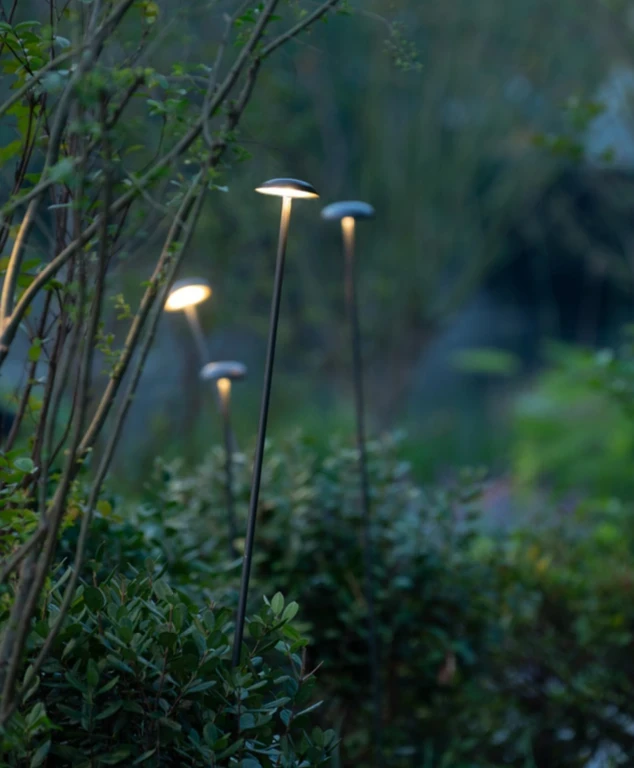
The walking layer comes first because it is the only one that is obligatory. Hooded poles — Acorn, Lily, a Drum head where the path is wider — set on the planting side, spaced at three to five times their height, at the low light level a garden actually needs. Nothing in this layer should be visible as a source from the terrace. Its job is to draw the line of the route and the position of every step.
Layer two: the planting
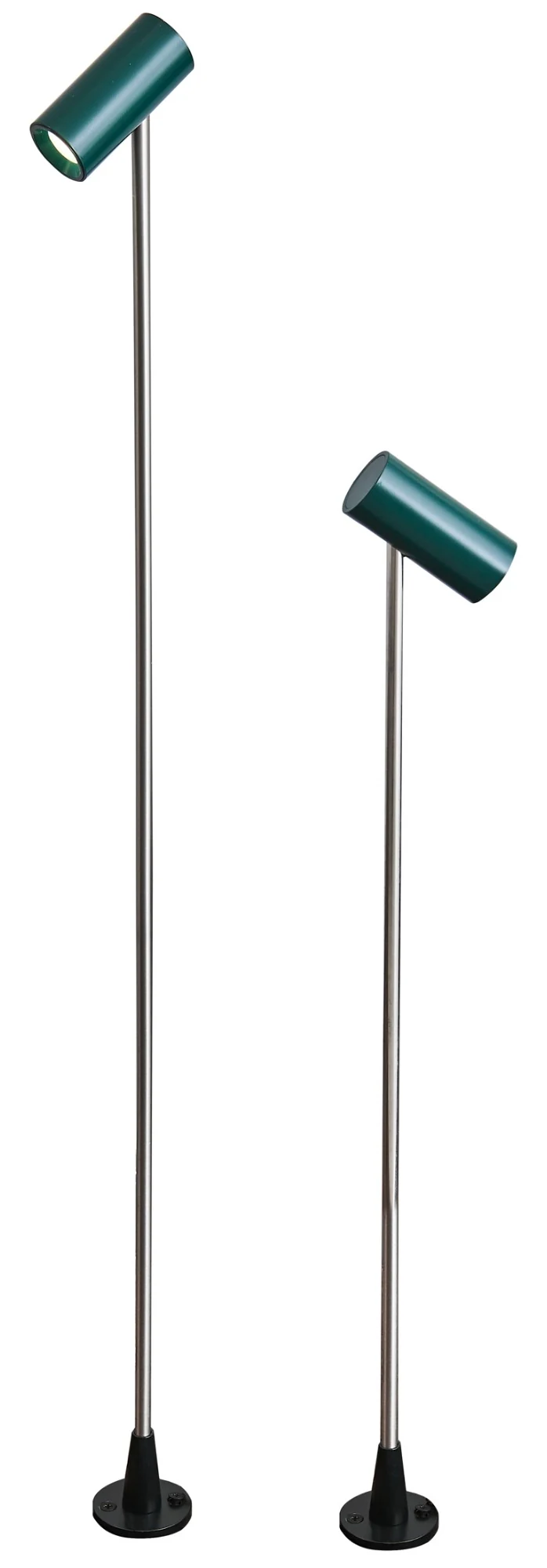
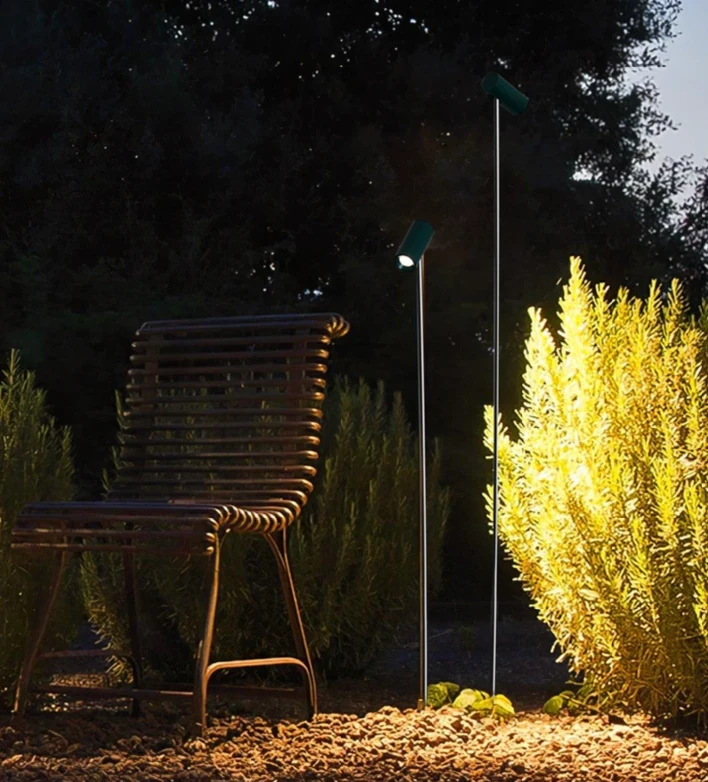
This is the layer that makes the picture. Choose three to five things worth seeing after dark — an olive, a multi-stem tree, a clipped hedge, a textured wall, a large pot — and give each one its own narrow-beam light. A Heron spot on a 525 to 925 mm stem, tilted from below at 36°, models a trunk or a shrub in relief the way daylight never does; its matt green head is invisible in the foliage by day. The Cane pole does the same job with three rotating heads on one stem where you want to light a bed on one side and a path on the other. Keep the level modest: a lit specimen only needs to be brighter than what surrounds it, not bright in itself.
Fill the middle distance with markers, not floods. A Bloom sphere at the corner of a bed, a Berry globe on its stalk among grasses, a Reed stem in a drift of perennials: these give the eye points of light at different heights and depths, which is what makes a dark garden read as deep rather than flat.
Layer three: the terrace and the threshold
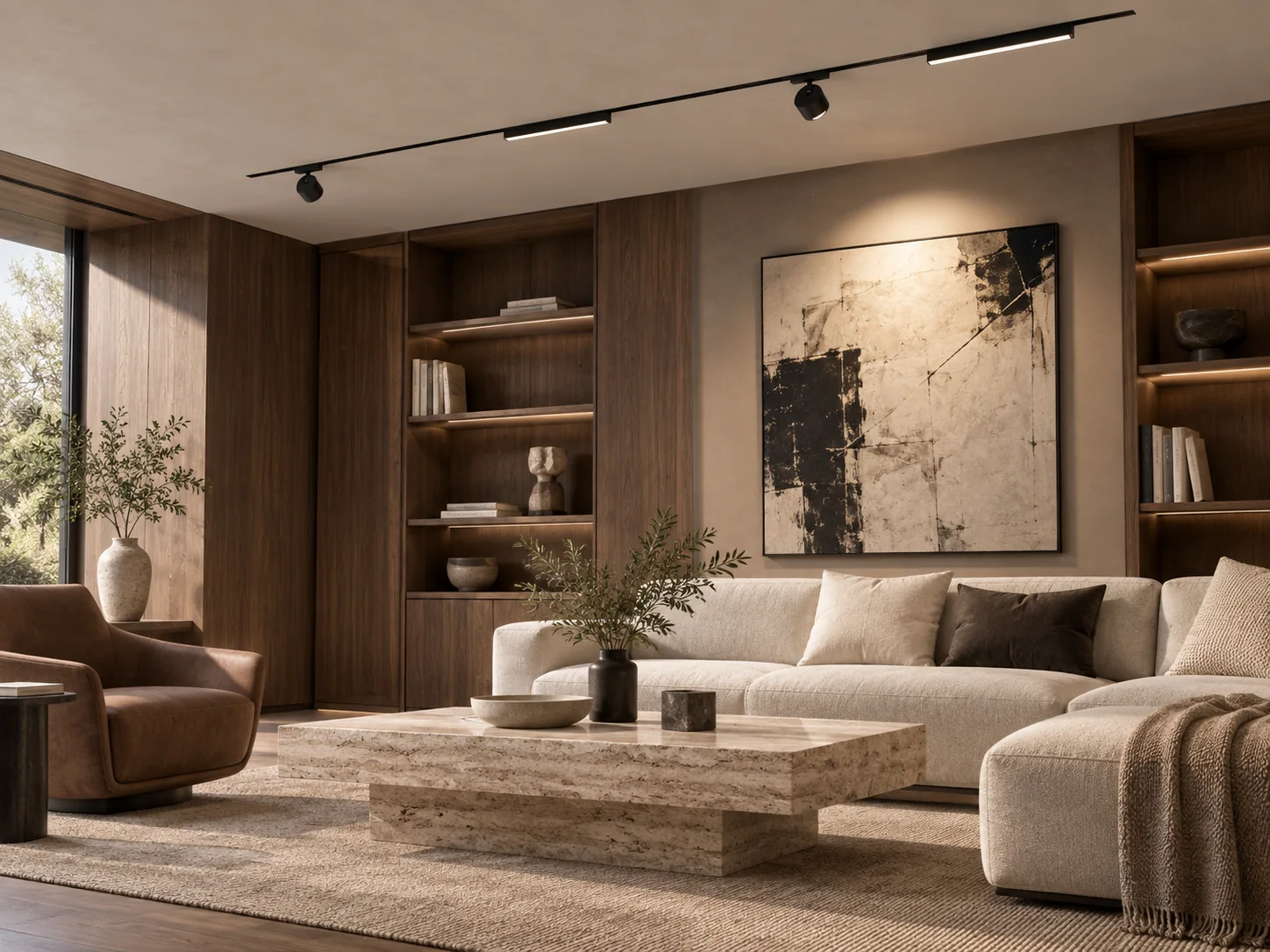
The terrace is where people sit, so it takes the only task-level light in the garden — and it should come from above or from the wall, not from the floor. A Vane wall light washing the house wall up and down lights the seating without a fitting in the sightline, and turns the facade into the backdrop of the picture. At the door, a bollard or a low pole on each side of the threshold marks the transition, warm and glare-controlled. Portable lamps — a Porter or Signet on the table — finish the layer at eye level and move with the evening.
One colour temperature, one voltage
Hold the whole garden at 3000 K. Mixed colour temperatures are the most visible mistake an outdoor scheme can make, and they are easy to avoid when every pole, spot and wall light in a family shares the same source. Run the pole and spot layers on 24 V DC — class III, IP65, one driver in a dry enclosure — so the circuit is safe among roots, hoses and children, and can be extended when the planting matures. Only the wall lights and the threshold need mains.
Control by scene, not by switch
Three circuits are enough: path, planting, terrace. The path layer stays on from dusk on a timer or a daylight sensor; the planting layer is the one you switch on for the view; the terrace comes on when people go out. Dim the planting circuit where the control allows it — a specimen tree at half output is more beautiful than at full, and the window stays a window rather than a mirror. Plan it this way and the garden works from the sofa, from the lawn and from the street, at the lowest installed power a landscape scheme can have.