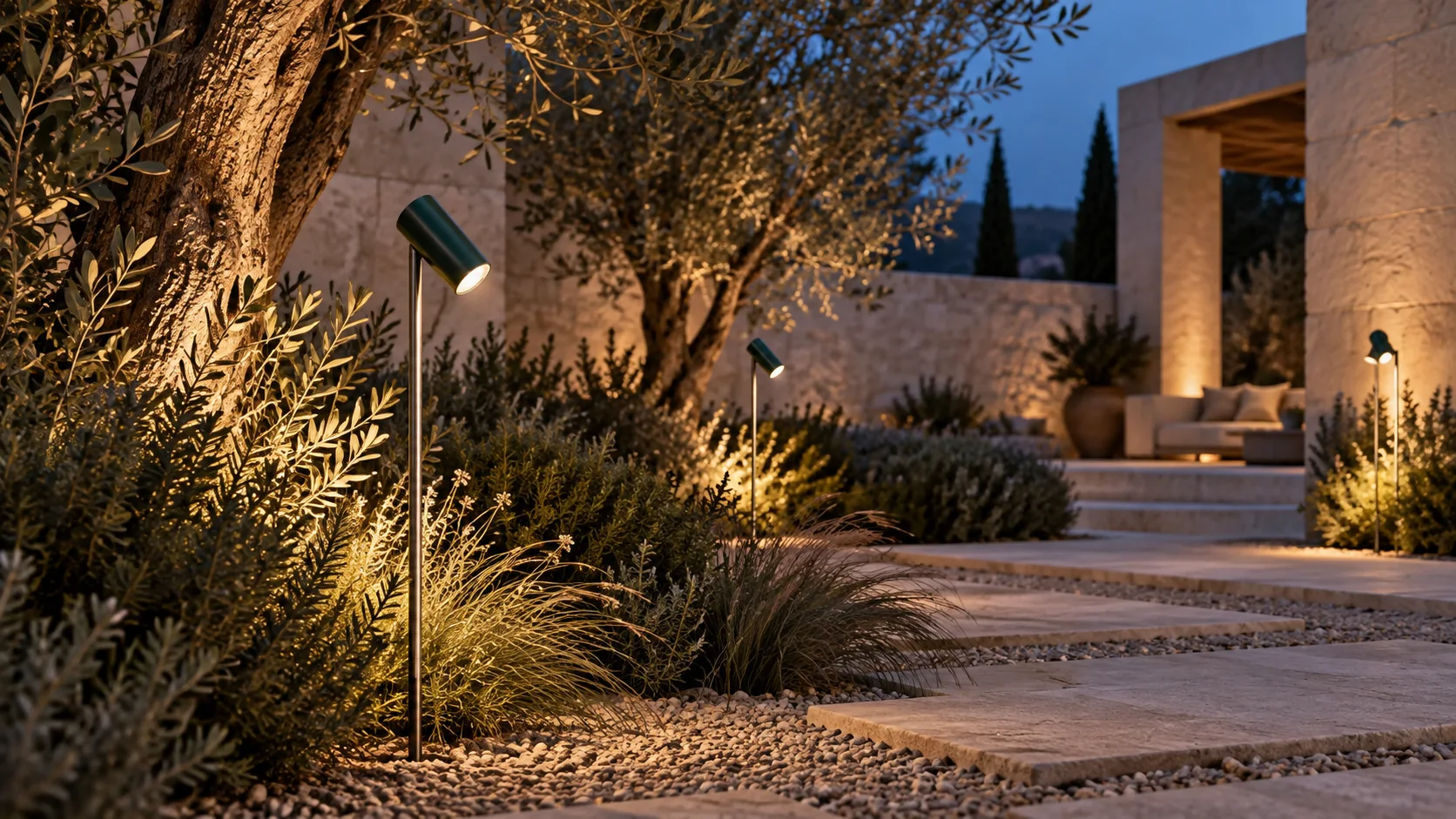
Most garden lighting is specified from a catalogue photograph taken at night. The fixture glows, the planting is a silhouette, and the picture looks right. Walk the same garden at noon and the problem shows: a row of Ø 100 mm bollards standing in a lavender border like fence posts. The slim pole family exists to solve that daytime problem. Bloom, Heron, Acorn and Lily are four heads on the same idea — a stainless-steel stem in matt nickel, barely thicker than a plant support, with the light carried at the top so the fitting is read as part of the planting rather than as an object placed in front of it.
One stem, four ways of giving light
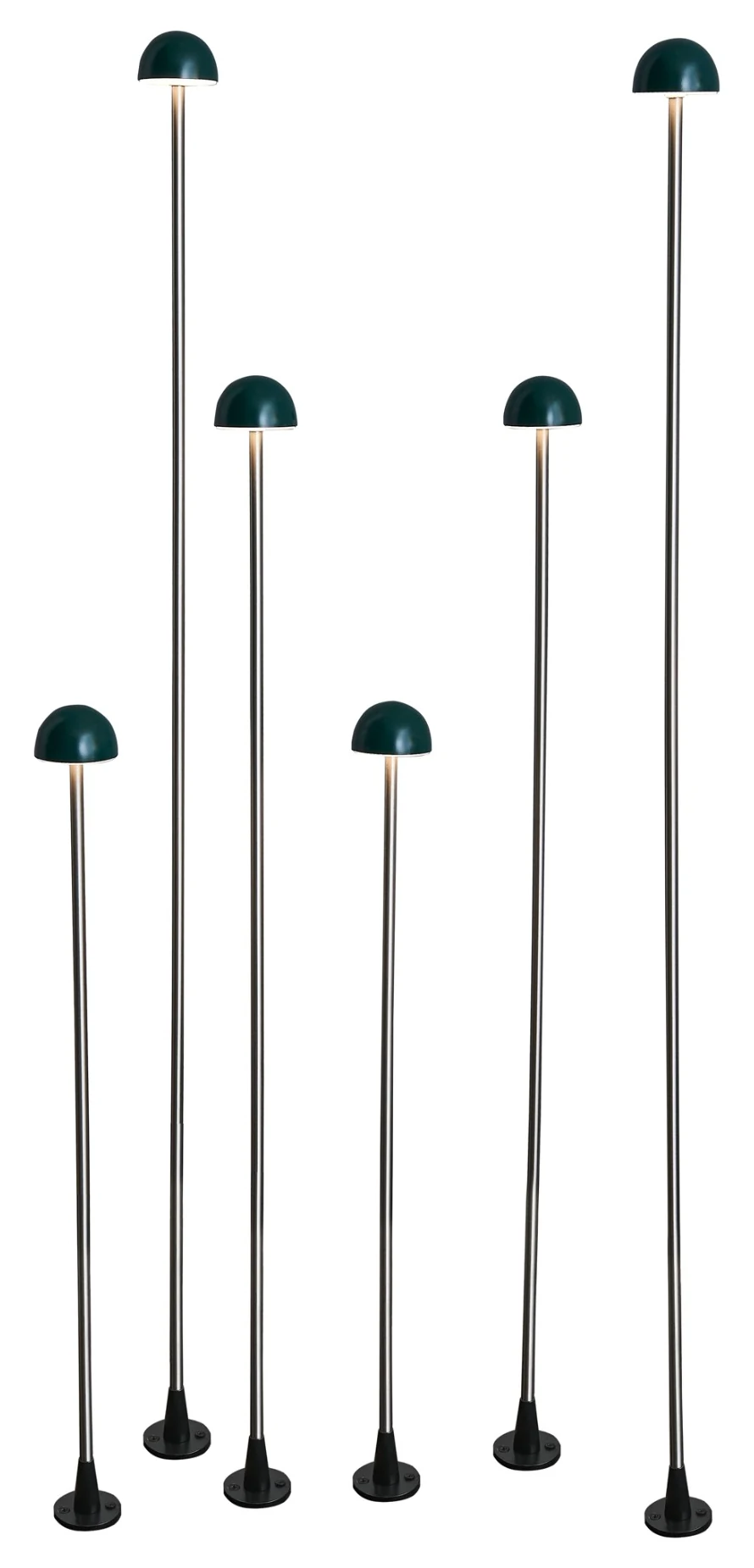
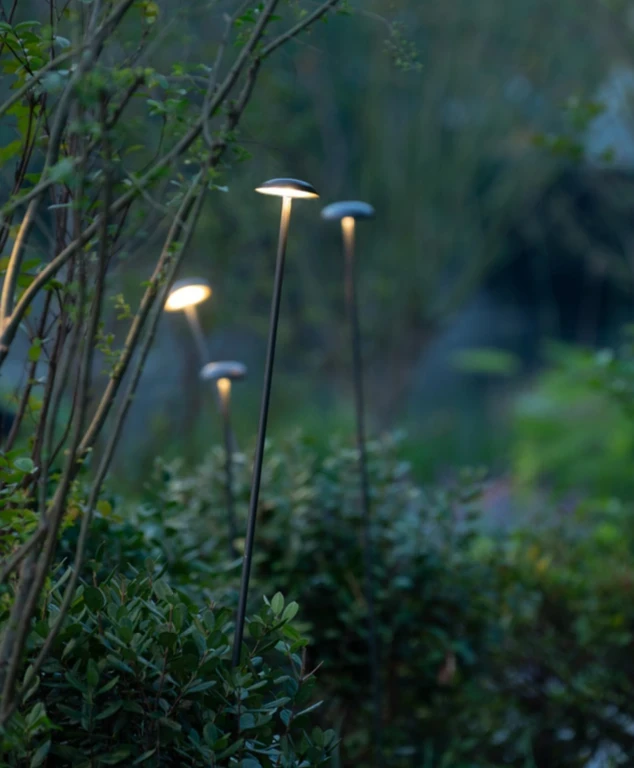
The four heads divide by what they do with the light. Bloom holds a Ø 40 mm opal sphere at the top of the stem and throws a full 360°. It has no bright side and no dark side, so from a terrace it reads the same from every seat — a small moon over the border, 1 W per pole. Acorn closes the stem with a Ø 50 mm domed cap in matt green; the source sits entirely under the hood and spreads 180° downward, laying an even circle around the pole at 4 W. Lily does the same with a wider, shallower Ø 80 mm saucer: at 5 W the circle is broader and softer, wide enough to cover the full width of a path in one wash.
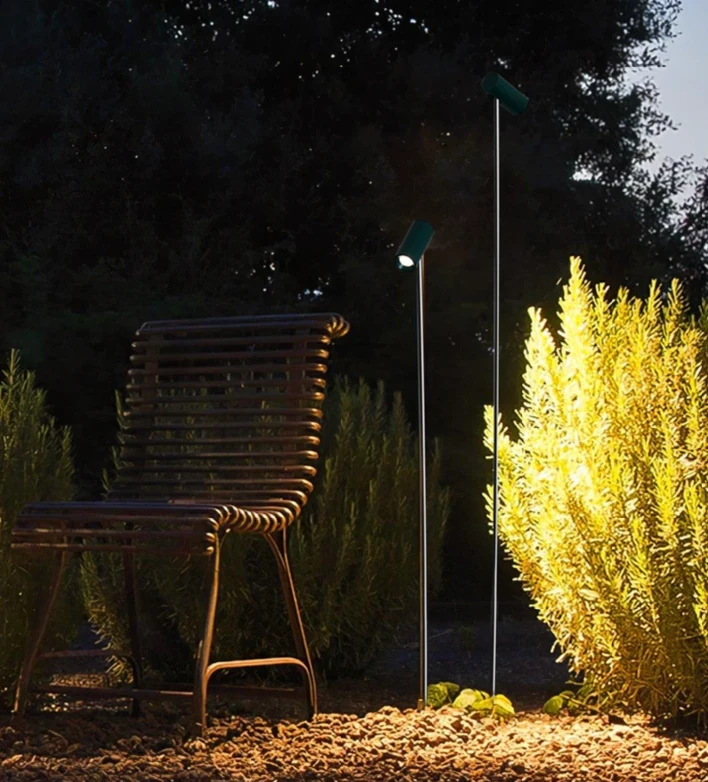
Heron is the one member that aims rather than glows. A Ø 31.5 mm cylinder head in matt green tilts on the stem and carries a 36° optic, so 3 W picks out a specimen shrub, a trunk or a section of hedge instead of washing the whole bed. The head is finished green for the same reason the other caps are: at noon it should vanish into foliage.
Three heights, the same luminaire
Each head comes on three stem lengths — roughly 520, 720 and 920 mm depending on the head — and the three are the same product electrically and optically. That matters more than it sounds. A run of Acorns can sit low through groundcover and rise where the path opens onto a lawn, and the whole run still belongs together. A cluster of Blooms at staggered heights reads as one group of lights hovering at different levels rather than three products bought separately. Heron's tallest stem takes the same tilting head from a low border up to shoulder-high planting.
24 V SELV: safe among roots and hoses
The entire family runs on 24 V DC from an external driver, protection class III. In a garden that is not a detail. A low-voltage circuit can be cut by a spade, flooded by a sprinkler or chewed by something and remain safe to touch; it can be extended when the beds are replanted without an electrician's return visit; and its cable can run shallow along a border. Every pole is IP65 with CRI above 90 at 3000 K, so leaf greens and stone read true, and the whole circuit shares one colour temperature by construction.
Why slim is the advantage
Outdoor lighting is where most catalogues turn heavy: cast bollards, thick posts, large glass. That vocabulary suits a hotel driveway; it overwhelms a villa garden or a small terrace border. A Ø 16 mm Reed stem, a Ø 40 mm Bloom sphere, a Heron head the size of a marker pen — these are scaled to the plants they stand among, not to the car park. The result is a garden that is designed by the planting in daylight and by the light after dark, with no third element competing for attention.
Specify them as a set: Acorn or Lily along the path for the walking surface, Heron on the specimens you want to see from the house, Bloom where a soft marker is enough — a pool surround, a step, the edge of a bed. One 24 V driver, one colour temperature, one stem finish, and nothing on the plan that looks like a fence post.